

California e-bike laws require bikes are limited to 750-watt motors or less, and you need no license, registration, plate, or insurance to ride one, though you must still follow California traffic laws and any local rules your city has adopted.
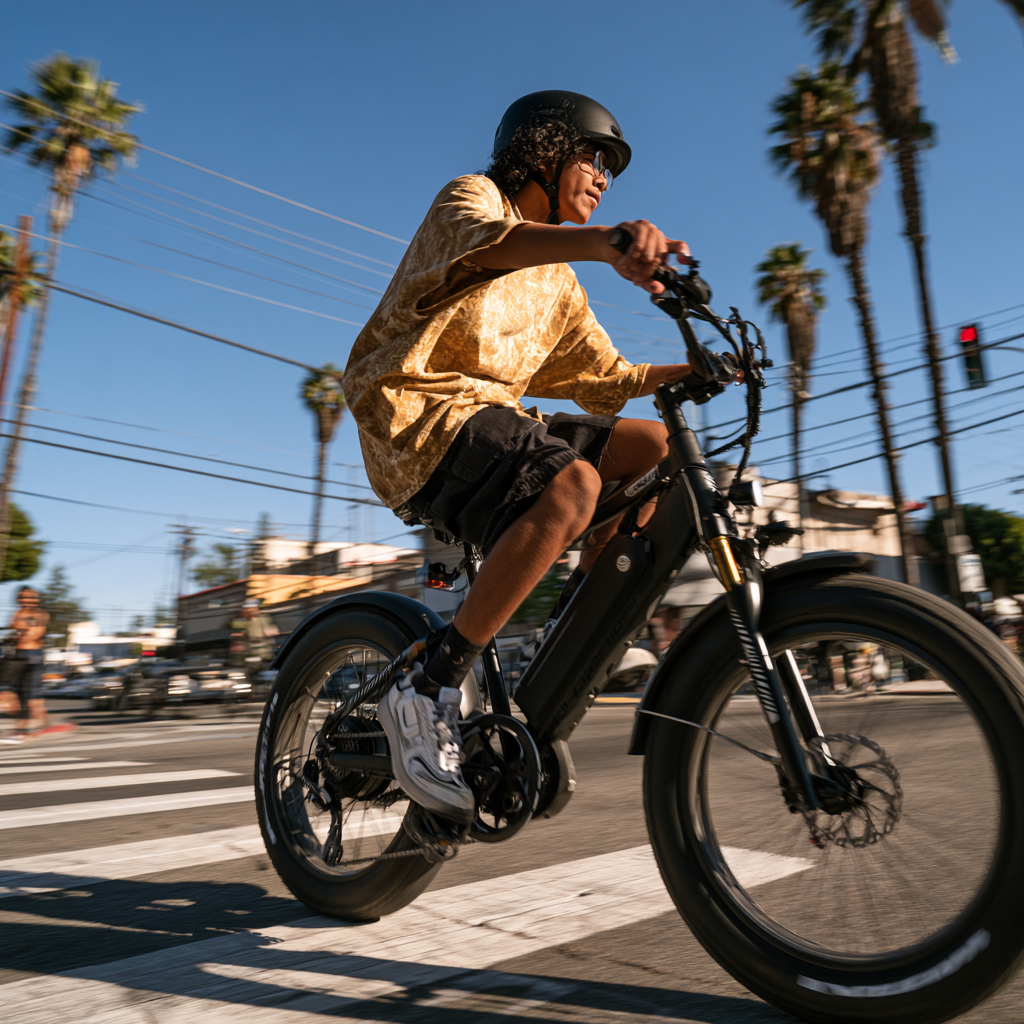
What Is a Legal E-Bike in California?
In California, an e-bike is a bicycle with fully functional pedals and an electric motor no stronger than 750 watts, roughly equal to one horsepower. If your motor exceeds that limit, California no longer treats your bike as an e-bike. It becomes a moped or motorcycle, which requires a driver’s license, registration, and insurance to operate legally.
California divides all legal e-bikes into three classes, and the class your bike falls into determines almost every other rule that applies to you.
What Are Class 1, Class 2, and Class 3 E-Bikes?
California sorts e-bikes into three categories based on how the motor works and how fast it can take you. Manufacturers are required to attach a permanent label to every e-bike showing the class, top assisted speed, and motor wattage, check your frame if you are not sure which class you own.
| Class | How the Motor Works | Top Assisted Speed | Throttle? |
| Class 1 | Assists only while you pedal | 20 mph | No |
| Class 2 | Assists while pedaling or by throttle alone | 20 mph | Yes |
| Class 3 | Assists only while you pedal, speedometer required | 28 mph | No |
Who Can Ride an E-Bike in California?
There is no minimum age to ride a Class 1 or Class 2 e-bike under California state law. If you want to ride a Class 3 e-bike, you must be at least 16 years old.
Your city or county may have stricter age rules on top of what the state requires. It is always worth checking your local ordinances before your first ride.
Do You Need a Helmet on an E-Bike?
Helmet rules in California depend on your age and the class of your e-bike:
- Under 18: You must wear a helmet every time you ride, regardless of the class.
- 18 or older on a Class 1 or 2: State law does not require a helmet, though we strongly encourage you to wear one.
- If you’re 18 or older and riding a Class 3 e-bike, a helmet is required by law, since Class 3 bikes can assist you up to 28 mph.
Do You Need a License or Registration for an E-Bike?
No. You do not need a driver’s license, registration, or license plate to ride a Class 1, 2, or 3 e-bike in California. This is one of the clearest differences between a legal e-bike and a moped or motorcycle.
The exception is if your e-bike has been modified beyond its original class. Once a bike no longer fits the legal e-bike definition, the DMV treats it like any other motor vehicle, and you need the right documentation to ride it legally.
Where Can You Ride an E-Bike in California?
Where you can legally ride depends largely on your e-bike’s class. Local governments, state parks, and trail systems can all set stricter rules on top of state law, so what is allowed in one city might be completely different a few miles away.
Roads and Bike Lanes
All three classes can ride in regular traffic lanes and in Class II bike lanes, the painted lanes along the side of a road. When you are on public roads, you are subject to the same traffic laws as cars and traditional bicycles.
Bike Paths and Trails
Class 1 and Class 2 e-bikes are generally allowed on paved, multi-use bike paths unless a local rule says otherwise. Class 3 e-bikes are typically not permitted on shared bike paths unless the path runs directly alongside a road.
Sidewalks
State law does not specifically ban e-bikes from sidewalks, but most California cities do. You should assume sidewalk riding is not permitted unless your city’s municipal code specifically allows it.
Local Rules and State Parks
California State Parks, national forests, and local governments all have the authority to restrict e-bikes beyond the state baseline. Some parks ban throttle-powered bikes on trails, some cities ban all e-bikes on beach boardwalks. Always check the local rules before you ride somewhere new.
What our California e-bike accident lawyers see consistently among riders who use the Pacific Electric Trail through Rancho Cucamonga and the Santa Ana River Trail near San Bernardino is confusion over which class of bike belongs there.
Riders on Class 3 e-bikes often assume the paved, multi-use surface means every class is welcome, and they end up cited or turned away when posted signage restricts assisted speeds above 20 mph.
We also see riders who never checked a park’s specific rules for boardwalks or trail sections get caught off guard when a ranger or local ordinance enforces a stricter rule than the one they read about online.
Confirming the posted rules for a specific trail before you ride saves you a citation and, if a crash happens, keeps your compliance from being used against you.
How Fast Can an E-Bike Go in California?
The speed limit for an e-bike in California refers to how fast the motor can legally assist you, not your total top speed.
- Class 1 and Class 2: Motor assistance stops at 20 mph.
- Class 3: Motor assistance stops at 28 mph.
You can pedal faster than those limits under your own power without breaking any law. What you cannot do legally is modify the motor to keep assisting you above the limit for your class, doing that removes your bike from legal e-bike status entirely.
What Equipment Does Your E-Bike Need?
Required Labels and Speedometers
Every e-bike must display the manufacturer’s permanent label showing its class, top assisted speed, and motor wattage. Class 3 e-bikes must also have a working speedometer.
Lights and Reflectors for Night Riding
When you ride after dark, your e-bike must have:
- A white front headlight visible from at least 300 feet
- A red reflector on the rear
- White or yellow reflectors on your pedals or ankles
Passenger Rules
You can only carry a passenger if your e-bike has a seat built specifically for one. Class 3 e-bikes cannot carry passengers under any circumstances.
What Makes an E-Bike Illegal in California?
An e-bike becomes an unregistered motor vehicle the moment it no longer fits the legal definition. Here is what pushes a bike out of legal e-bike status:
- Motor over 750 watts: The bike is automatically reclassified as a moped or motorcycle.
- Throttle exceeding 20 mph: A throttle bike that propels you above 20 mph is no longer a legal Class 2 e-bike.
- Non-functional or missing pedals: A legal e-bike requires fully operable pedals, without them, the bike fails the definition.
- Aftermarket speed unlock kits: Any modification that causes the motor to assist beyond your class limit voids the bike’s legal status.
If an officer determines your modified e-bike qualifies as an unregistered motor vehicle, you can be cited and the bike may be impounded.
Can You Get a DUI on an E-Bike in California?
Yes. California law makes it a misdemeanor to ride any bicycle, including an e-bike, while under the influence of alcohol or drugs. If your e-bike has been modified to the point it qualifies as a motor vehicle, you face the same full DUI penalties that apply to car drivers, which are far more serious.
In our experience handling bicycle and e-bike cases in San Bernardino County, officers along corridors like Route 66 and Foothill Boulevard treat an e-bike stop much like a routine bicycle stop until they notice the motor’s size or a missing manufacturer label, at which point the analysis shifts entirely.
Our California bicycle accident lawyers regularly see riders surprised that a citation issued for what looks like a minor bicycle violation carries misdemeanor exposure rather than the infraction they expected.
When the same incident involves a motor that exceeds the legal wattage limit, the case can escalate quickly from a bicycle-level citation to something closer to a standard DUI charge. Knowing your bike’s actual classification before you ride after drinking is the clearest way to know what you are actually risking.
Who Pays After an E-Bike Crash?
When a crash happens, the person who caused it is generally responsible for your medical bills, lost wages, and property damage. Establishing who was at fault, what the law calls liability, is the foundation of any injury claim. Pursuing that claim is not about being litigious, it is about making sure someone else’s carelessness does not cost you everything.
Here is how the most common scenarios break down:
- A driver hits you: The driver’s auto insurance is typically responsible for your costs. If they are uninsured, your own uninsured motorist coverage may step in.
- You hit a pedestrian: Your homeowners or renters insurance may cover the liability. If it does not, you could be held personally responsible for their damages.
- A defective part causes the crash: The manufacturer or the retailer that sold you the bike may be liable under California product liability law.
Right after a crash, the other driver’s insurance company starts moving fast, and they are working to protect their profits, not to make sure you get what you deserve. They may call asking for a recorded statement, and that statement is designed to benefit them. Let us step in and handle the insurance company so you can focus on recovering.
A pattern we see repeatedly in e-bike crash claims across San Bernardino and Riverside counties is an adjuster pointing to the rider’s helmet use or sidewalk riding as a reason to shift fault, even when neither had anything to do with causing the crash.
We have handled claims where a driver ran a stop sign along Foothill Boulevard or Waterman Avenue and the insurer still tried to argue the e-bike rider was partly at fault for being on the sidewalk.
Riders treated at Arrowhead Regional Medical Center or St. Bernardine Medical Center after these crashes are often contacted by the adjuster before they have even seen a follow-up specialist, and early statements taken during that window tend to work against the rider later.
Knowing which rules actually apply to your class of e-bike helps you push back when an adjuster tries to manufacture a fault argument that does not hold up.
What to Do After an E-Bike Crash
The steps you take in the hours after a crash can protect your health and your legal rights.
Call 911
Request police and paramedics immediately. A formal police report creates an official record of what happened and is one of the most important documents in any injury claim.
Get Medical Care Right Away
Go to the emergency room even if you feel okay. Adrenaline hides serious injuries. Having a medical record from day one is critical. Emergency care can be costly, and the resulting medical documentation helps protect your claim.
Document Everything at the Scene
Photograph the vehicles, your e-bike, your injuries, road conditions, and any signage. Collect the driver’s name, license plate, and insurance information, and get contact details from any witnesses who saw what happened.
Preserve Your Bike and Gear
Do not repair your e-bike or discard your damaged helmet or clothing. These are physical evidence that can directly support your claim.
Do Not Give a Recorded Statement
The other driver’s insurance company will call quickly asking for a recorded statement. Politely decline. That statement is designed to protect them, not to help you receive fair compensation.
Call Krasney Law Accident Attorneys
You do not have to face the insurance companies alone. Contact us, and let us walk you through every step.
Injured? Get Legal Help Today
If you were hurt in an e-bike crash, the other driver’s insurance company is already working to limit what they pay you. Our job is to make sure you receive everything you are owed. We represent injury victims throughout San Bernardino, Riverside, Moreno Valley, Hemet, and the Temecula-Murrieta corridor, and we know how to hold negligent parties accountable.
You never pay a fee if we do not recover money for you. We advance all case costs, police reports, medical records, and expert witnesses, so you never need money upfront to get started. Your consultation is free and can happen as soon as the same or next day.
Call today!
Frequently Asked Questions
Is a 750-Watt Motor Legal on a California E-Bike?
Yes. A 750-watt motor is the maximum allowed under California law, making it fully legal. Any motor more powerful than 750 watts automatically reclassifies your bike as a moped or motorcycle.
Are Throttle-Powered E-Bikes Legal in California?
Yes, throttle e-bikes are legal as Class 2 e-bikes, as long as the throttle does not push you above 20 mph and the bike has fully operable pedals.
Do You Need Insurance to Ride an E-Bike in California?
No. California does not require insurance for a legal Class 1, 2, or 3 e-bike. However, your homeowners or renters insurance may provide some liability coverage if you cause an accident while riding.
Can Police Impound an Illegally Modified E-Bike in California?
Yes. If an officer determines that your modified e-bike qualifies as an unregistered motor vehicle, they can issue citations and have the bike impounded on the spot.
Are E-Bikes Allowed on California College Campuses?
Each campus sets its own policy. Many UC and CSU campuses restrict or ban e-bikes in high-traffic pedestrian areas and interior walkways, so check your specific campus rules before you ride.


Comments are closed, but trackbacks and pingbacks are open.